Package-size research
The shrinkflation watch: household package and unit-price baselines
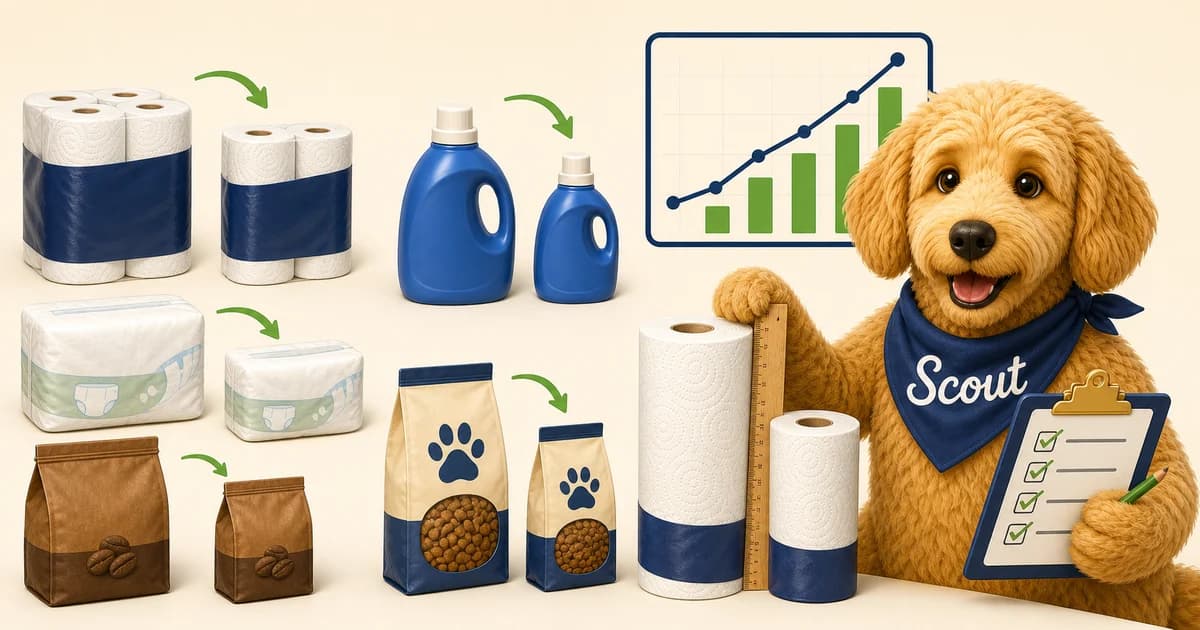
A single current snapshot cannot prove that a package shrank. This report establishes a transparent baseline—package sizes, normalized units, and current price spreads—so future observations can identify real shrinkflation without guessing.
Live data refresh pending
The current sample does not yet contain enough compatible package records for a baseline.
Baseline categories
0
At least two compatible records
Source-backed observations
0
Current product and package records
Largest current spread
—
Comparison risk, not proof of shrinkage
Visual summary
Largest current normalized unit-price spreads
Higher spreads mean the package sticker price needs more scrutiny.
The chart will appear after enough fresh compatible records are available.
Downloadable evidence
Source-backed research table
Every price record links to its retailer source. Empty or incompatible evidence is withheld rather than estimated.
No fresh records currently clear this study's publication rules. The methodology remains visible, but unsupported results are not generated.
How the study works
- Collect current validated household-product records in the disclosed reference market.
- Group records by category and retain only sourced high- or medium-confidence prices with normalized units.
- Record the visible package description and calculate the lowest and highest current normalized unit price within each compatible category.
- Report the unit-price spread as a shopping-risk signal, not as proof of historical shrinkage.
- Preserve timestamps and source links so later observations can be compared against the baseline.
What the results do not prove
- Current size differences between products are not automatically shrinkflation.
- A shrinkflation claim requires the same compatible product or lineage observed at two points in time.
- Formulas, quality tiers, diaper sizes, paper-sheet formats, and product variants can make superficially similar items incompatible.
- Sparse categories remain outside the ranking instead of receiving estimated values.
Practical interpretation
What shoppers should take away
The sticker price is least reliable when package counts and formats vary widely.
Compare cost per sheet, load, diaper, ounce, item, bag, or another category-specific unit.
Use this baseline to spot categories worth monitoring; do not accuse a product of shrinking without historical package evidence.
Get The Scout Desk
Weekly price-check tips before you shop.
Research FAQ
Questions about this study
Does this report prove that every listed product shrank?
No. It publishes a current unit-price and package baseline. Historical shrinkflation requires matching a compatible product across time.
Which household units are most useful?
Examples include price per 100 sheets for paper goods, per load for detergent, per diaper within the same size, and per ounce for compatible food or pet products.
Why can unit prices vary so much?
Brand, formula, package size, quality tier, seller, fulfillment, promotions, and genuinely different product formats can all contribute.
How will Price Scout detect shrinkflation later?
By comparing compatible product identities, package measurements, normalized units, timestamps, and prices across repeated observations.