Original Price Scout research
The 2026 household essentials price index: how five retailers compare
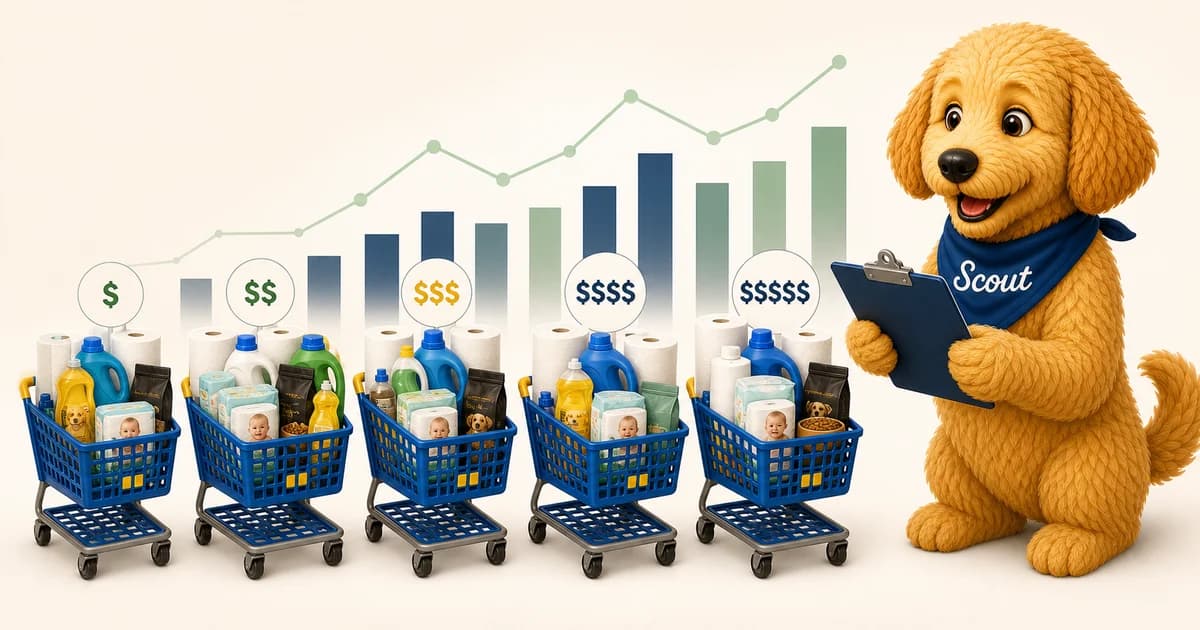
The fairest retailer comparison is not a sticker-price basket. Price Scout normalizes each category into sheets, loads, ounces, counts, or another compatible unit, then measures how close each retailer is to the lowest observed unit price.
Live data refresh pending
The source sample is not yet broad enough to identify a covered index leader.
Retailers observed
0
Current source coverage across the two markets
Retailers ranked
0
Require at least three compatible categories
Comparable records
0
Every record has a retailer source
Categories sampled
0
Household and repeat-purchase categories
Visual summary
Average relative unit-price index
Lower is better. The lowest compatible retailer in each category equals 100.
The chart will appear after enough fresh compatible records are available.
Downloadable evidence
Source-backed research table
Every price record links to its retailer source. Empty or incompatible evidence is withheld rather than estimated.
No fresh records currently clear this study's publication rules. The methodology remains visible, but unsupported results are not generated.
How the study works
- Use two disclosed reference markets: South Florida ZIP 33130 for Publix coverage and Cincinnati ZIP 45202 for Kroger coverage. Walmart, Target, and Dollar General act as bridge retailers.
- Load the newest validated Price Scout snapshot for each household category.
- Exclude unavailable, unsourced, low-confidence, and incompatible-unit records.
- Within each category and market, set the lowest current compatible unit price to an index of 100 and calculate each other retailer relative to it.
- Average only the categories where a retailer has a valid normalized price; disclose coverage instead of filling gaps with estimates.
What the results do not prove
- The index is a current household-product sample, not a complete grocery basket.
- Coupons, loyalty offers, BOGOs, taxes, memberships, fees, and personalized promotions are not deducted.
- A retailer with limited source coverage can move substantially when additional categories become available.
- Kroger and Publix are not directly compared across regions; each is indexed against retailers available in its own disclosed market.
- H-E-B, Sprouts, and The Fresh Market are not blended into this two-market national bridge sample; their Austin, Phoenix, and Greensboro indexes keep regional prices in locally relevant ZIPs.
Practical interpretation
What shoppers should take away
Use the relative index to compare normalized value, not the immediate checkout total.
Open the source record before shopping because package size and fulfillment can change.
A retailer can lead one category while trailing badly in another, so category-level results matter more than a blanket winner.
Get The Scout Desk
Weekly price-check tips before you shop.
Research FAQ
Questions about this study
Which retailer is cheapest for household essentials?
It depends on the categories, package formats, location, and current source coverage. The live index reports the lowest average normalized position only when enough compatible records are available.
Why not compare the package price?
Package prices reward smaller packs. Normalized units such as cost per load, ounce, item, or 100 sheets make materially different package sizes more comparable.
Are coupons included?
No. The index uses the source-backed price record and keeps coupons, account offers, rewards, BOGOs, and future gift-card value separate.
How often is the index updated?
The underlying Price Scout snapshots are scheduled daily. This page automatically withholds stale data after 48 hours.